31.08.2026
Smart sauna and remote start: how to safely start your sauna from your phone
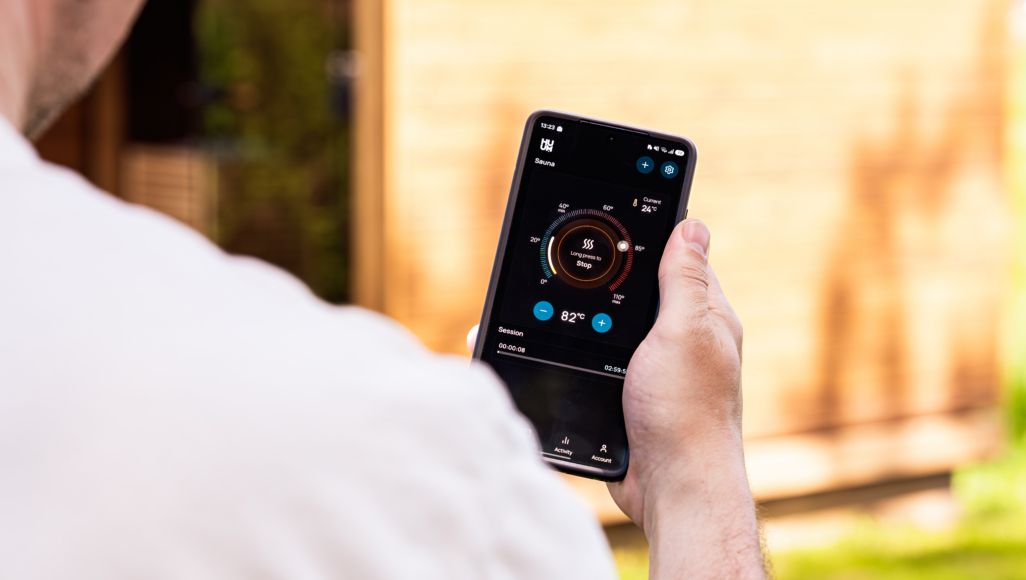
Smart sauna and remote start make it possible to begin heating your sauna from your phone, but they also raise an important question: how can you make sure the sauna is safe to start remotely?
What if a towel or another object has been left on the heater? Or what if someone enters the sauna room after you have already checked it?
With UKU 4.2, the user must check the sauna room before remote start is enabled. Once the sauna has been confirmed as safe, the door sensor detects if the sauna door is opened, while other built-in safety features monitor the heating process.
Remote start is just one part of the smart sauna experience. For a broader look at remote control, sauna bookings, real-time alerts and other app features, explore what’s new in the HUUM app.
Let’s take a closer look at how Remote start safety works, what the UKU sensors monitor, and why correct sensor placement matters.
Remote start safety: what it is and why it matters
Remote start safety is designed to make remote sauna heating safer by requiring a physical check of the sauna room before remote start is enabled.
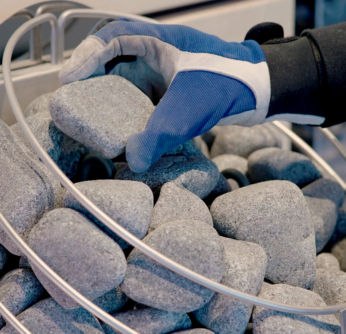
When you start the heater while you are at the sauna, you can first check that there is nothing on or near the heater that could create a fire hazard when heated.
When starting the sauna remotely, however, you cannot inspect the sauna room at that exact moment.
This is why the UKU control system includes the Remote start safety function, which is enabled by default.
It applies both when starting the sauna remotely right away and when using a scheduled booking.
The function does not inspect the sauna room for you. Before enabling remote start, you must make sure that there are no towels or other objects on or near the heater that could create a hazard when the heater is turned on.
You should also make sure that no one is inside the sauna room.
Once you have checked the sauna room, you need to confirm on the UKU control panel that the sauna is safe for remote start.
Confirming the sauna is safe for remote start
Confirming the sauna is safe for remote start is done directly on the UKU control panel after you have checked the sauna room.
If the control panel is installed outside the sauna room, close the sauna door before confirming safety.
To confirm that the sauna is safe, press and hold the control panel button for about three seconds until the safety confirmation prompt appears. Select Yes.
If the control panel is installed inside the sauna room, confirm the safety on the control panel, leave the sauna, and close the door.
After successful confirmation, three gray dots appear on the control panel screen, indicating that the sauna is ready for remote start.
Confirming the safety does not start the heater. It simply enables the sauna to be started later from the HUUM app, either immediately or at a scheduled time.
If you select No or do not respond to the prompt, the system will not allow the sauna to be started from the HUUM app, either immediately or through a booking.
The UKU 4.2 manual describes this as the safety confirmation prompt and confirms that three gray dots indicate that remote start has been enabled.

To confirm Remote start safety, press and hold the UKU control panel button for about three seconds until the safety confirmation prompt appears.
Confirming safety before every remote start
Confirming safety before every remote start is not necessary as long as the SAFE status remains active.
Once you have confirmed that the sauna is safe for remote start, the SAFE status remains active until the sauna door is opened or power to the UKU main module is interrupted.
If the door is opened during heating, you will need to inspect the sauna room again and confirm that it is safe before the next remote start or scheduled booking.
If you start heating and then stop it without opening the sauna door, the SAFE status remains active and the sauna can be started remotely again later.
The role of the door sensor in remote start
The role of the door sensor in remote start is to monitor whether the sauna door is open or closed.
If the door is left open, the control system prevents the heater from starting or stops heating if a heating cycle is already active.
If the door is opened after Remote start safety has been confirmed, the SAFE status is cancelled.
Before the next remote start, you need to inspect the sauna room again and confirm that it is safe.
Changing the Remote start safety setting
Changing the Remote start safety setting is only possible when the heater is not heating.
Press and hold the control panel button. The remote start prompt — “Would you like to engage the remote start?” — appears first. To continue to the settings menu, keep holding the button.
Then go to Safety Settings → Remote start safety and select the desired setting.
The UKU 4.2 manual refers to this setting as “Remote start safety: Enabled/Disabled.”
It also warns that disabling the confirmation allows the sauna to be started remotely without first confirming that conditions inside the sauna are safe.
Safety goes beyond remote start
Safety goes beyond remote start with UKU 4.2, as the control system continues to monitor the sauna after heating has begun.
An important part of this is the safety sensor, which is installed directly above the heater and monitors the temperature in that area.
The safety sensor also incorporates a thermal fuse. This is a hardware-based safety measure and does not depend on the mobile app.
In other words, UKU safety is not based on software alone: essential protective functions are also built into the control system hardware.
The bench sensor measures temperature and humidity
The bench sensor measures temperature and relative humidity inside the sauna room and provides UKU with information about conditions away from the direct heat of the heater.
The safety sensor and bench sensor have different roles. The safety sensor helps protect the sauna from overheating, while the bench sensor provides temperature and humidity readings from the sauna room.
When both the safety sensor and the bench sensor are installed, the control panel displays the temperature measured by the bench sensor rather than the safety sensor.
Measuring relative humidity is particularly important when UKU is used to control a steamer.
The system uses the humidity reading from the bench sensor to regulate the steamer according to the selected settings.
Sensor placement affects measurement accuracy
Sensor placement affects measurement accuracy because the temperature is not the same throughout the sauna room.
The air directly above the heater is usually hotter than elsewhere in the sauna, while ventilation openings and the proximity of doors and windows can also affect sensor readings.
Reliable temperature measurement therefore depends heavily on where each sensor is installed.
Because the safety sensor and bench sensor serve different purposes, they also have different installation requirements.
The safety sensor must be installed directly above the heater, either on the wall or on the ceiling.
Its exact position depends on the type of heater and the applicable installation requirements.
Whenever possible, the bench sensor should be installed on the opposite side of the sauna from the safety sensor, where it is less affected by direct heat from the heater.
According to the UKU 4.2 manual, the bench sensor must be installed 150 mm from the ceiling, at least 500 mm from ventilation ports, and at least 200 mm from doors, windows and corners. Read more in the UKU 4.2 user manual.
Correct sensor placement gives the control system more accurate information about conditions inside the sauna room and allows it to regulate the heater accordingly.
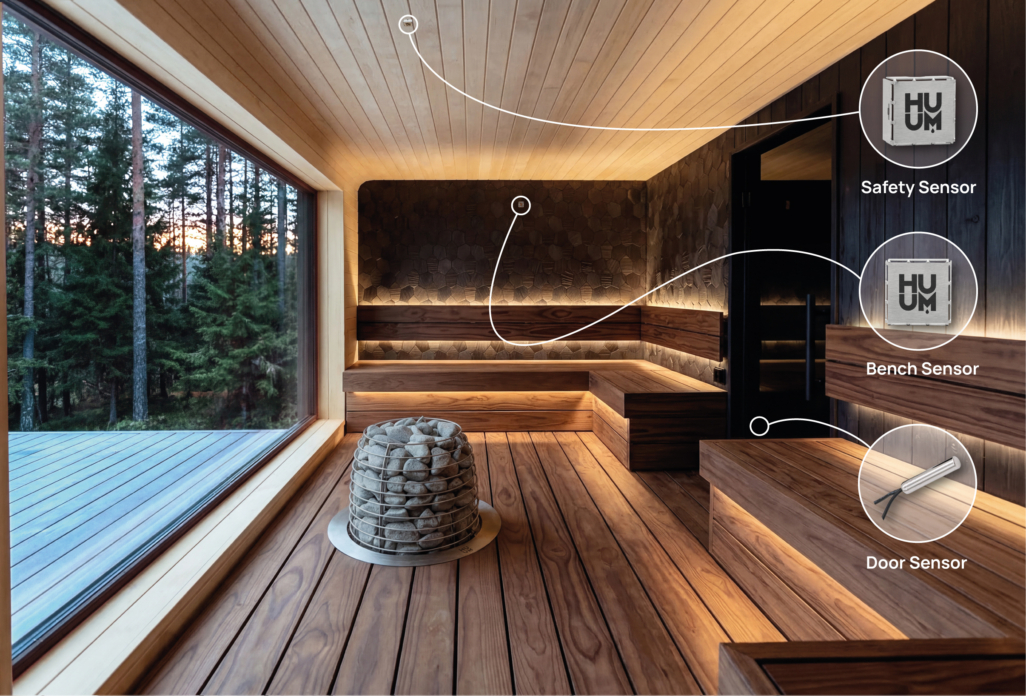
Example placement of the UKU safety sensor, bench sensor and door sensor in a sauna room.
Failure detection monitors how the sauna heats up
Failure detection monitors how the sauna heats up and stops heating if the temperature does not rise sufficiently within a defined period.
With UKU 4.2, the required temperature rise depends on which sensors are installed.
When only the safety sensor is used, the temperature must rise by at least 40°C within 60 minutes.
When both the safety sensor and bench sensor are installed, the required increase is at least 20°C within 60 minutes.
If the required temperature rise is not reached, the heater is switched off.
One possible reason for slow heating is heat loss.
If this error occurs, check that the sauna doors and windows are closed and that any ventilation ports intended for drying the sauna are in the correct position for heating, as specified in the sauna instructions.
The UKU manual specifically lists open doors or windows, poor insulation, insufficient heater power and incorrect sensor installation as possible reasons for insufficient temperature rise.
This means the control system does more than monitor the current temperature. It also checks whether the sauna is heating up as expected.
Overheating pauses help protect the sauna
Overheating pauses help protect the sauna by interrupting continuous full-power heating at regular intervals.
If the heater operates continuously at full capacity, the control system pauses heating after every 30 minutes.
These pauses help reduce the risk of surfaces near the heater overheating.
Continuous full-power operation may indicate, for example, that the heater is not powerful enough for the sauna room or that the ventilation has not been designed correctly.
Overheating pauses can be disabled in the settings, but HUUM recommends keeping them enabled for safety.
Convenience and safety go hand in hand
Convenience and safety go hand in hand when remote sauna control is combined with a physical safety check and UKU’s built-in safety features.
The UKU door sensor, temperature sensors and other built-in safety features do not replace the physical inspection of the sauna room.
Instead, they help monitor the door status and the heating process once the sauna has been confirmed as safe.
For the control system to work as intended, the sauna room must be properly designed, the heater must be correctly sized, and both the ventilation and sensors must be installed according to the requirements.
This makes it possible to enjoy the convenience of starting your sauna from your phone while keeping the physical safety check an essential part of remote start.