29.09.2026
Sauna and conversation: why some of the best conversations happen on the sauna bench
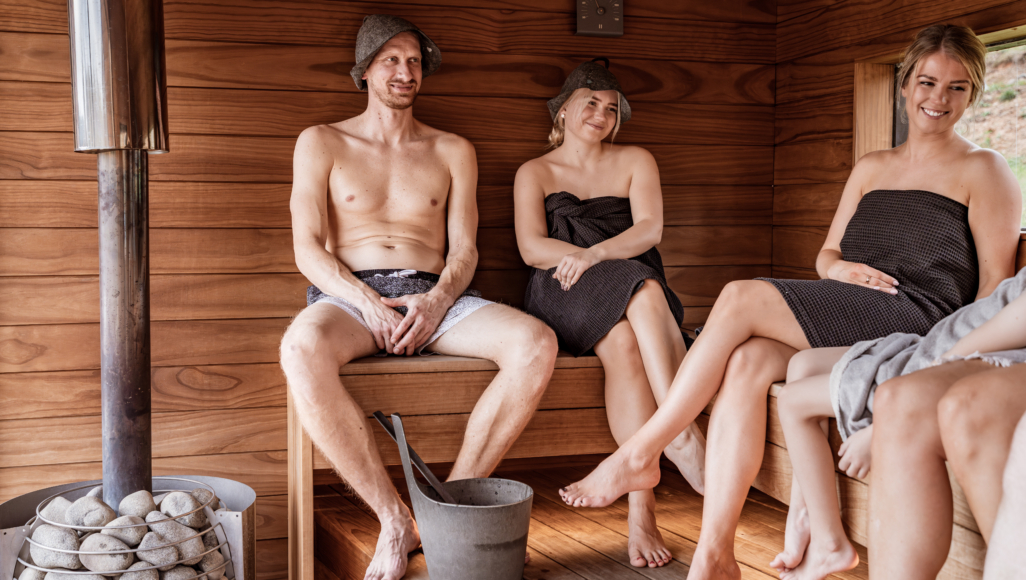
Sauna and conversation have long belonged together in Estonian sauna culture.
On the sauna bench, a conversation can move from everyday matters to topics that somehow never find the right moment elsewhere.
The sauna environment gives conversation a different character from many situations in daily life.
So what is it about the sauna that can make talking feel easier?
The answer is not simply the heat. Sauna culture, shared rituals, a slower pace and an environment with fewer everyday distractions all play a part.
Sauna is more than a place to wash
Sauna is more than a place to wash in Estonian culture.
For generations, it has been connected with family traditions, whisking, healing practices, celebrations and shared Saturday evenings.
The importance of these traditions is also reflected in the smoke sauna tradition of Võromaa, which was inscribed on UNESCO’s Representative List of the Intangible Cultural Heritage of Humanity in 2014.

UNESCO highlights practices such as bathing together as a family, welcoming guests to the sauna and passing sauna-related knowledge and skills from one generation to the next.
Sauna continues to hold a strong place in Estonian culture today.
In a survey included in the book Saun. Ajalugu, kultuur, tervis, ehitus, 42% of Estonians considered sauna bathing a very important part of Estonian identity, while another 33% considered it important.
That does not mean people primarily go to the sauna to talk. In the same survey, 41% of respondents named relaxation as the most important part of sauna bathing, while only 3% chose socialising.
Conversation may not be the main purpose of a sauna session, but it can become an important part of what we remember about it afterwards.
The sauna bench slows everyday life down
The sauna bench slows everyday life down by removing many of the things that usually compete for our attention.
Everyday conversations often happen while we are doing something else.
We check our phones at the dinner table, watch the road while talking in the car, think about the next meeting at work or deal with several things at once at home.
There is much less multitasking on the sauna bench.

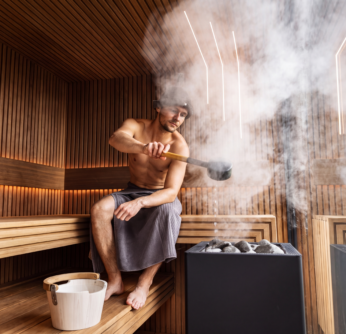
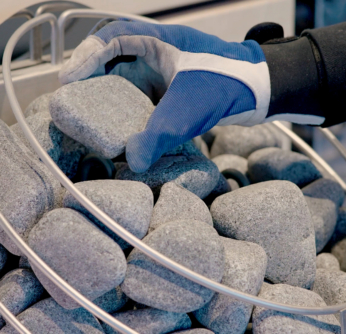
You sit, throw water onto the hot stones, listen to the hiss and feel the heat change around you. There is nothing that needs to be finished at the same time and nowhere you need to rush off to.
That also changes where your attention goes. When familiar distractions fall away, it can become easier to focus on the people sharing the sauna with you.
Leil gives conversation its own rhythm
Leil gives conversation its own rhythm, just as it gives the sauna session its rhythm.
In Estonian sauna culture, leil refers to the wave of heat and humidity that fills the sauna when water is thrown onto hot stones.
Most people move between the sauna bench, cooling down and resting several times during one session.
This creates a natural sequence: leil, cooling down, rest and another round in the sauna.
Conversation can follow the same pattern. A thought that begins on the sauna bench may continue while cooling down or only return when everyone sits down for the next round.
The first round may be about the week that has just passed. Later, the conversation may move towards something that needs more time.
A sauna evening does not require one uninterrupted conversation from beginning to end.
Sitting side by side changes the conversation
Sitting side by side changes the conversation in subtle ways.
On the sauna bench, people usually sit next to one another or at a slight angle rather than face to face as they might during an interview or a formal meeting.

It may seem like a small detail, but it can change the atmosphere.
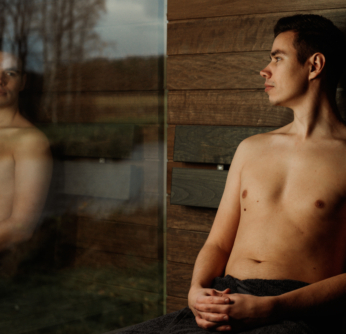
There is no need to maintain constant eye contact. You can look at the heater, out of a window or simply ahead of you. Every thought does not have to be followed immediately by another question.
In the sauna, someone can finish what they want to say without the other person having to respond to every sentence. Sometimes it is enough to sit beside someone and listen.
Talking is no longer the purpose of the whole encounter. It simply becomes part of a shared experience.
Titles and roles fade into the background in the sauna
Titles and roles fade into the background in the sauna because many of the usual signs of status are no longer present.
In everyday life, clothing, workplaces and job titles tell us a great deal about one another. On the sauna bench, many of these signals disappear.
That does not mean differences between people suddenly cease to exist. They may, however, become less important for a while.
Researchers studying public saunas in Finland have described a similar phenomenon.
Their research highlights the sauna as a socially equalising environment where familiar status markers are reduced and people from different backgrounds can meet on the same bench.
The social role of the sauna in Estonia is not limited to families and friends either.
The book Saun. Ajalugu, kultuur, tervis, ehitus describes, for example, a sauna at the University of Tartu where researchers and doctoral students of different nationalities began meeting regularly.
Alongside relaxing, conversations ranged from students’ grades to research methodology.
Saunas have also been built into workplaces in Estonia, giving colleagues a place not only to relax but also to spend time together, exchange ideas and continue conversations that began during the working day.
The sauna can therefore create an environment where professional roles move into the background for a while and people simply meet as people.
Some stories only come out in the sauna
Some stories only come out in the sauna because the setting can create a moment that does not seem to exist elsewhere.
This side of sauna culture comes through particularly clearly in Anna Hints’ reflections on the smoke sauna.
In an interview included in Saun. Ajalugu, kultuur, tervis, ehitus, Hints recalls an experience from her childhood after the death of her grandfather.
She went to the smoke sauna with her grandmother, aunt and cousin. There, her grandmother began speaking about things she had never discussed with them outside the sauna.
Hints has described the sauna as a place where “healing stories” can be told, including stories that may be difficult to share elsewhere.
The memory illustrates another role the sauna can have. Alongside leil and relaxation, it may create space for conversations that never seem to find the right moment in everyday life.
Of course, every sauna session does not have to turn into a deeply personal conversation.
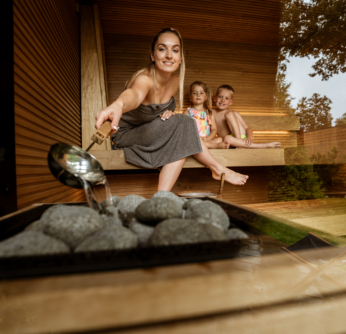
Most of the time, people talk about completely ordinary things: work, children, renovations, the weather or who should throw the next ladle of water onto the stones.
A meaningful conversation does not always have to be serious.
Sometimes what stays with us is simply an ordinary conversation with someone we have not had enough unhurried time with for a while.
Silence belongs to the sauna too
Silence belongs to the sauna too, and sometimes it is one of the best parts of the experience. After a round of leil, everyone may simply become quiet.
Water hits the hot stones, there is a brief hiss, and nobody needs to keep the conversation going with another sentence.
In everyday situations, we often rush to fill silence.
A longer pause can feel as though the conversation has run out or something has become uncomfortable.
In the sauna, silence has a natural place.

Attention shifts towards the heat, the leil and how your own body feels. Conversation can simply disappear for a moment.
That does not make being together any less meaningful.
The ability to share the same space without constantly needing to speak may be one of the distinctive social qualities of the sauna.
A good sauna evening does not need an agenda
A good sauna evening does not need an agenda because the best conversations are difficult to plan.
They often appear when there is enough time for them and nobody is trying to force the discussion in a particular direction.
Some conversations stay with us precisely because nobody set an objective for them or expected a particular outcome.
Perhaps some of the best conversations happen on the sauna bench simply because they are allowed to unfold at their own pace.
A good sauna experience depends on many things: temperature, the heater, the stones and good leil.
Years later, however, we may no longer remember exactly how hot the sauna was that evening.
We are far more likely to remember who was sitting beside us on the bench and what we talked about.
Frequently asked questions
There are fewer everyday distractions in a sauna, and the session naturally moves between leil, cooling down and resting. There is no need to keep talking constantly, which allows conversations to develop at a calmer pace.
No. Silence is a natural part of the sauna experience. Sitting quietly together, listening to the heater and focusing on the heat and leil can be just as much a part of sharing the sauna as conversation.
Yes. Although relaxation is an important reason for sauna bathing, the sauna has also traditionally been a place for families, friends, guests and communities to spend time together. Shared sauna traditions have been passed down through generations and remain part of Estonian culture today.
Sources
- Hõbepappel, U., Hõbepappel, L., Nellis, S. & Nellis, S. (2023). Saun. Ajalugu, kultuur, tervis, ehitus. Populus alba.
- Leipämaa-Leskinen, H., Syrjälä, H., Kauppinen-Räisänen, H. & Jaskari, M.-M. (2025). Socio-material construction of public saunas as third places. Journal of Place Management and Development. DOI: 10.1108/JPMD-12-2024-0144.
- UNESCO (2014). Smoke sauna tradition in Võromaa. Representative List of the Intangible Cultural Heritage of Humanity.